
Project Overview
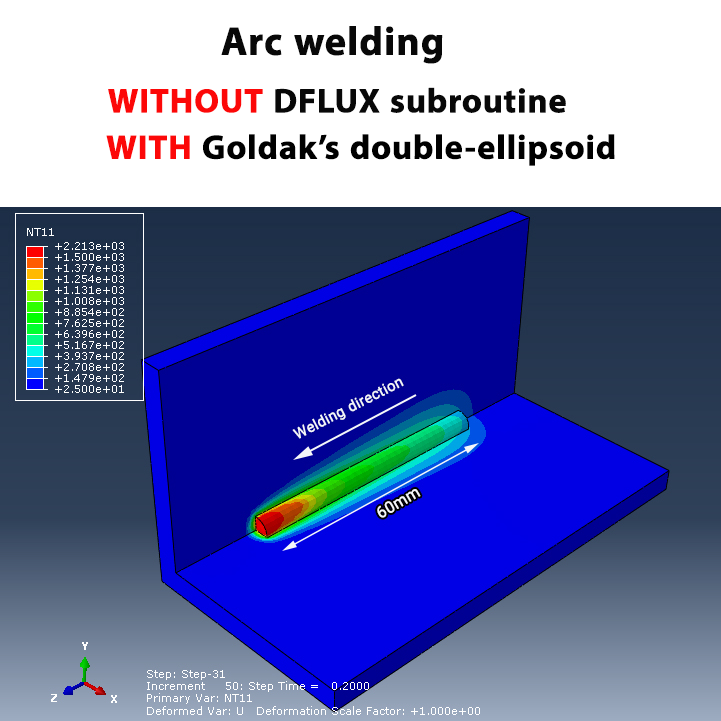
In this example, the arc welding process is simulated in Abaqus using the Goldak's double-ellipsoid heat source model.
In this simulation, a volumetric heat flux is used to represent the welding heat input. The Goldak's double-ellipsoid model is used to define the volumetric heat flux distribution around the welding pool.
The heat source is defined as a function of position and time, allowing the movement of the welding heat source to be simulated during the welding process.

Arc welding simulation using Goldak's double-ellipsoid heat source.
Goldak's Double-Ellipsoid Heat Source
The Goldak's double-ellipsoid heat source model is adopted to calculate the distribution of the volumetric heat flux used as the heat input around the welding pool.
The equations of the Goldak heat source model are defined as a function of position and time, together with several heat-source parameters.
The parameters a, b, Cf, and Cr define the size and shape of the ellipsoidal heat source. These parameters are obtained from experimental analysis.
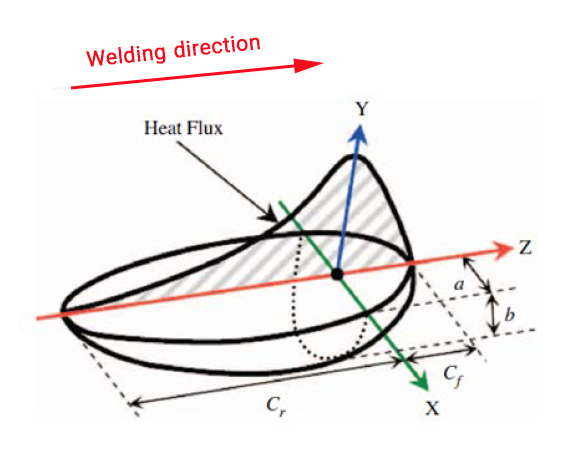
Parameters defining the size and shape of the Goldak double-ellipsoid heat source.
Welding Parameters
The welding parameters used in this simulation are:
- Welding voltage: 20 V
- Welding current: 110 A
- Welding efficiency: 0.8
- Welding speed: 10 mm/s
These parameters are used to define the welding heat input and the movement of the heat source during the simulation.
Material Properties
The material of the plate is SUS304.
The material properties are temperature-dependent. The simulation considers the variation of density, thermal conductivity, specific heat, thermal expansion, elastic properties, and plastic properties with temperature.
What You Will Learn
- How to simulate an arc welding process in Abaqus.
- How to use the Goldak's double-ellipsoid heat source model.
- How to define volumetric heat flux in Abaqus.
- How to define a moving welding heat source.
- How to define heat flux as a function of position and time.
- How to define the Goldak heat source parameters.
- How to define temperature-dependent material properties.
- How to model SUS304 for an arc welding simulation.
- How welding voltage and current affect the heat input.
- How to define welding efficiency and welding speed in the model.
Key Features
- Arc welding simulation in Abaqus.
- Goldak's double-ellipsoid heat source model.
- Volumetric heat flux.
- Moving welding heat source.
- Position- and time-dependent heat source.
- Temperature-dependent material properties.
- SUS304 material.
- Welding voltage of 20 V.
- Welding current of 110 A.
- Welding efficiency of 0.8.
- Welding speed of 10 mm/s.
- Step-by-step training video.
- Abaqus CAE file.
- Abaqus INP file.
- Excel material file.
- Research article included.
Project Information
Important information about this project
Payment & Support
Need help with your purchase?
Secure Payment
Your payment is processed securely through our online payment system.
Need Help?
If you have any questions about this product, please contact us by email.
saeedofmoeini@gmail.com
There are no reviews yet.