
Project Overview
This tutorial focuses on the simulation of a Consolidated Undrained (CU) triaxial test using the Abaqus software.
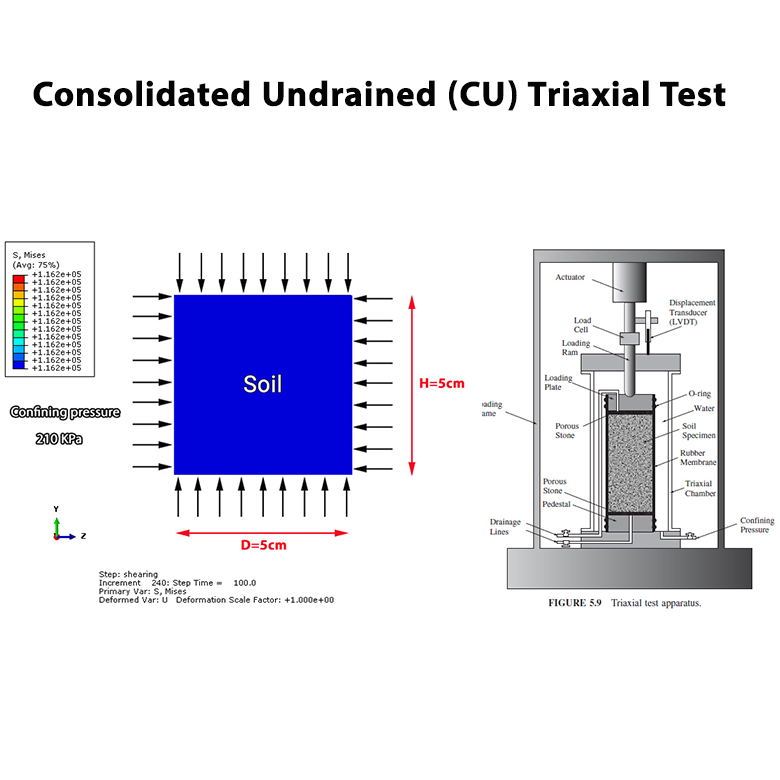
The model is based on Example 5.7 from the Sam Helwany book. A cylindrical clay specimen is first consolidated under an all-around confining pressure and then subjected to axial loading under undrained conditions.
The Abaqus analysis is used to obtain the stress–strain behavior and the pore water pressure response of the clay specimen. The numerical results are compared with the hypothetical test data presented in the reference example.
Model Description
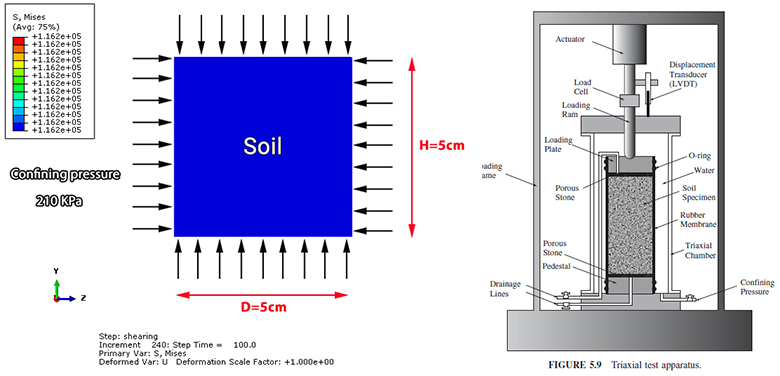
The soil specimen is modeled using a two-dimensional axisymmetric finite element model. The specimen has a diameter of 5 cm and a height of 5 cm.
The specimen is modeled using a pore fluid/stress axisymmetric element, allowing the soil deformation and pore water pressure to be considered in the analysis.
The clay is assumed to be normally consolidated and is modeled using the Extended Cam-Clay model. The Cam-Clay parameters are the same as those determined from the hypothetical test data in Example 5.6.
Analysis Steps
The analysis is performed in two steps to simulate the consolidated undrained triaxial test.
Step 1: Consolidation
In the first step, an all-around confining pressure of 210 kPa is applied to the clay specimen.
Drainage is permitted through the top surface during consolidation. The Geostatic option is also invoked to establish equilibrium and ensure that the initial stress condition falls within the initial yield surface of the Cam-Clay model.
Step 2: Undrained Shearing
At the beginning of the second step, the drainage condition at the top surface is removed, making the top surface impervious. The top and bottom surfaces are therefore undrained during shearing.
The loading plate is forced to move downward by 0.127 cm. The duration of the shearing step is 100 seconds.
The relatively rapid loading rate, together with the impervious boundaries, causes excess pore water pressure to develop during shearing.
Undrained Conditions
The model is analyzed under undrained conditions. The top and bottom surfaces of the soil specimen are considered impervious, preventing water from draining through these surfaces during the shearing stage.
As a result, excess pore water pressure develops inside the soil specimen during the application of the vertical load.
Deviator Stress vs. Axial Strain
One of the main objectives of this simulation is to obtain the relationship between deviator stress and axial strain.
The deviator stress versus axial strain curve obtained from Abaqus is compared with the corresponding curve presented in the Sam Helwany book.

Excess Pore Water Pressure
The development of excess pore water pressure during the undrained shearing stage is also investigated.
During the undrained shearing stage, the excess pore water pressure develops within the clay specimen due to the impervious boundaries and the relatively rapid application of the shearing load.
The relationship between excess pore water pressure and axial strain is obtained from the Abaqus analysis.

Comparison with Sam Helwany Book
The numerical results obtained from Abaqus are compared with the results presented in Example 5.7 of the Sam Helwany book.
The comparison includes both the deviator stress versus axial strain relationship and the excess pore water pressure versus axial strain relationship.
What You Will Learn
- How to model a cylindrical soil specimen in Abaqus.
- How to simulate a Consolidated Undrained (CU) triaxial test.
- How to apply a confining pressure of 210 kPa.
- How to define the consolidation stage.
- How to perform the shearing stage under undrained conditions.
- How to define impervious surfaces for the soil specimen.
- How to select an appropriate loading time for an undrained test.
- How to obtain deviator stress versus axial strain.
- How to investigate excess pore water pressure.
- How to obtain excess pore water pressure versus axial strain.
- How to compare Abaqus results with reference results.
Key Features
- Consolidated Undrained (CU) triaxial test.
- Cylindrical soil specimen.
- 5 cm diameter and 5 cm height.
- 210 kPa confining pressure.
- Two-step analysis.
- 100-second shearing step.
- Undrained loading conditions.
- Impervious top and bottom surfaces.
- Deviator stress versus axial strain.
- Excess pore water pressure versus axial strain.
- Comparison with Sam Helwany Example 5.7.
- Free Abaqus tutorial.
Project Information
Important information about this project
Payment & Support
Need help with this tutorial?
Free Tutorial
This Abaqus tutorial is available free of charge.
Need Help?
If you have any questions about this tutorial, please contact us by email.
saeedofmoeini@gmail.com
There are no reviews yet.