

Project Overview
This tutorial focuses on the simulation of the stress increase within a soil mass caused by a rectangular load using Abaqus software. This example is based on Example 3.10 from the Sam Helwany book.
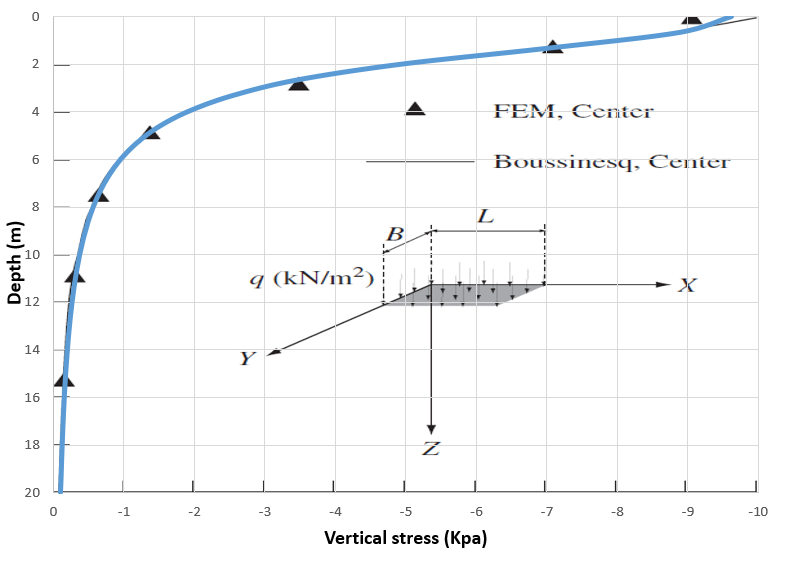
A rectangular pressure is applied to the surface of the soil, and the resulting increase in stress within the soil is obtained from the Abaqus analysis. The numerical results are then compared with the corresponding results obtained from the Boussinesq solution.
Model Description
The soil is modeled as a three-dimensional rectangular block with a length of 100 m, a width of 100 m, and a height of 50 m.
A rectangular loading area is defined on the top surface of the soil. The loading area has a length of 4 m and a width of 2 m.

Soil Properties
The soil is assumed to behave as a linear elastic material. The mechanical properties used in the Abaqus model are defined according to the reference example.
The Young's modulus of the soil is 1 × 10⁷ kPa and the Poisson's ratio is 0.3.
Rectangular Loading
A uniform pressure of 10 kPa is applied to the rectangular loading area on the top surface of the soil.
The applied pressure produces an increase in stress within the soil mass. The stress distribution is obtained from the Abaqus analysis and is investigated at different locations within the soil.
Increase of Stress Within the Soil
The main objective of this analysis is to determine the increase in stress within the soil caused by the rectangular surface load.
The stress distribution obtained from Abaqus is extracted from the numerical model and compared with the corresponding values from the theoretical solution.

Boussinesq Solution
The theoretical stress increase caused by the rectangular loading is calculated using the Boussinesq solution.
The theoretical results provide a reference for evaluating the numerical results obtained from the Abaqus simulation.
Comparison of Results
The results obtained from Abaqus are compared with the results from the Sam Helwany book based on the Boussinesq solution.
This comparison is used to evaluate the accuracy of the numerical model and to verify that Abaqus can correctly reproduce the stress increase caused by a rectangular surface load.
What You Will Learn
- How to model a three-dimensional soil mass in Abaqus.
- How to define linear elastic soil properties.
- How to apply a rectangular surface pressure.
- How to model a 4 m × 2 m rectangular loading area.
- How to investigate the stress increase within the soil.
- How to extract stress results from the Abaqus model.
- How to use the Boussinesq solution as a theoretical reference.
- How to compare numerical and theoretical results.
- How to verify a geotechnical Abaqus model using analytical results.
Key Features
- Three-dimensional soil model.
- 100 m × 100 m × 50 m soil domain.
- 4 m × 2 m rectangular loading area.
- 10 kPa uniform surface pressure.
- Linear elastic soil behavior.
- Young's modulus of 1 × 10⁷ kPa.
- Poisson's ratio of 0.3.
- Stress increase within the soil.
- Boussinesq theoretical solution.
- Comparison with Sam Helwany Example 3.10.
- Free Abaqus tutorial.
Project Information
Important information about this project
Payment & Support
Need help with this tutorial?
Free Tutorial
This Abaqus tutorial is available free of charge.
Need Help?
If you have any questions about this tutorial, please contact us by email.
saeedofmoeini@gmail.com
There are no reviews yet.