
Project Overview
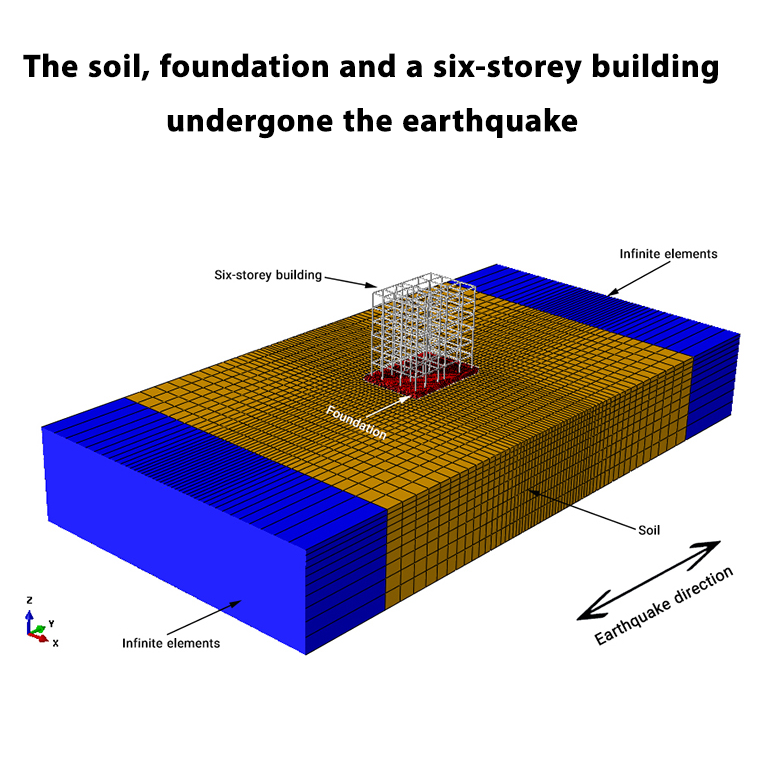
In this Abaqus tutorial, the soil, foundation, and a six-storey building are modeled to investigate the behavior of the system under earthquake loading.
A ground acceleration record is applied to the bottom of the soil in the Y direction to simulate seismic loading.

Soil, foundation, and six-storey building modeled in Abaqus.
Soil Model
The soil domain has a length of 100 m, a width of 70 m, and a height of 20 m.
Infinite elements are used around the outer boundaries of the soil domain to allow seismic waves to propagate out of the model and reduce artificial wave reflection back into the soil.

Infinite elements used at the outer boundaries of the soil domain.
Infinite Elements
The length of the infinite-element region is 20 m. These elements are used to diffuse the seismic waves away from the soil domain and minimize their reflection back into the model.
The infinite elements are distinguished from the main soil domain in the model to clearly identify the region used for wave radiation.
Concrete Foundation
The foundation is modeled with a length of 20 m and a width of 14 m.
Six-Storey Building
A six-storey building is placed on the foundation and is subjected to seismic excitation through the underlying soil.
The structural system is modeled together with the soil and foundation to investigate the response of the complete soil–foundation–building system during the earthquake.
Earthquake Loading
A ground acceleration record is applied to the bottom of the soil in the Y direction.
This ground motion is used to simulate the propagation of seismic waves through the soil and evaluate the response of the building and foundation.

Ground acceleration record applied at the bottom of the soil.
Ground acceleration record applied at the bottom of the soil.
Horizontal Displacement of the Building
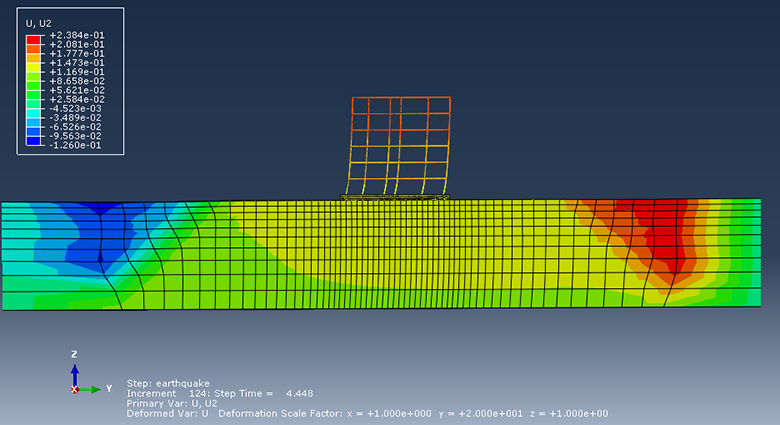
The horizontal displacement of the top point of the building is obtained from the Abaqus analysis to evaluate the seismic response of the structure.

Horizontal displacement of the top point of the building.
Relative Horizontal Displacement
The horizontal displacement of the top point of the building relative to the ground is also evaluated.
This result provides information about the relative movement of the building with respect to the ground during the earthquake.
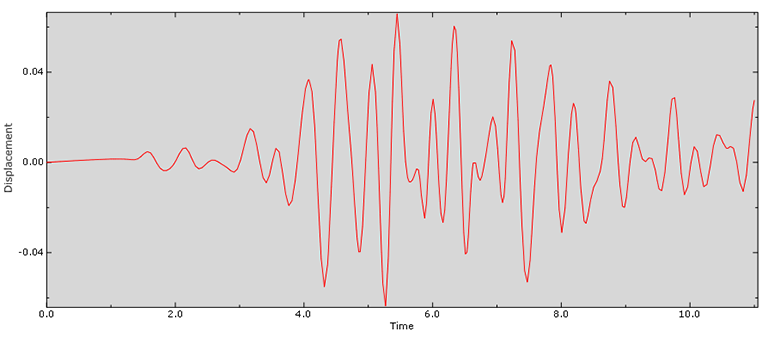
Horizontal displacement of the top point of the building relative to the ground.
What You Will Learn
- How to model soil–foundation–structure interaction in Abaqus.
- How to create a large three-dimensional soil domain.
- How to model a six-storey building on a concrete foundation.
- How to apply a ground acceleration record to the soil.
- How to apply earthquake loading in the Y direction.
- How to model infinite elements around the soil domain.
- How to use infinite elements to reduce artificial wave reflection.
- How to investigate seismic wave propagation through the soil.
- How to obtain the horizontal displacement of the building.
- How to calculate the horizontal displacement relative to the ground.
- How to evaluate the seismic response of a six-storey building.
Key Features
- Soil–foundation–building interaction.
- Six-storey building.
- Earthquake loading.
- Ground acceleration record.
- Soil domain: 100 m × 70 m × 20 m.
- Infinite-element region: 20 m long.
- Concrete foundation: 20 m × 14 m.
- Infinite elements for seismic wave radiation.
- Horizontal displacement of the top point of the building.
- Horizontal displacement relative to the ground.
- CAE file.
- INP file.
- Excel file containing ST-37 material data.
- Excel file containing the earthquake accelerogram.
Project Information
Important information about this project
Payment & Support
Need help with your purchase?
Secure Payment
Your payment is processed securely through our online payment system.
Need Help?
If you have any questions about this product, please contact us by email.
saeedofmoeini@gmail.com
Christopher Osasona
I’m unable to make payment on the website. Pls get back to me via email below
Osasonachristopher@gmail.com
Admin
Hello
You can use PayPal. Send me an email and I will help you
Rizwn Ullah
Hello Saeed, how are you doing
I need this CAE File and complete Excel sheet, can you please help me, I will appreciate,
I can send 5$ becuse i am student, Its urgent
+923139132819 whatsapp
Admin
Hello
You use this coupon code and get 10 euros discount
P9GCST9V