
Project Overview
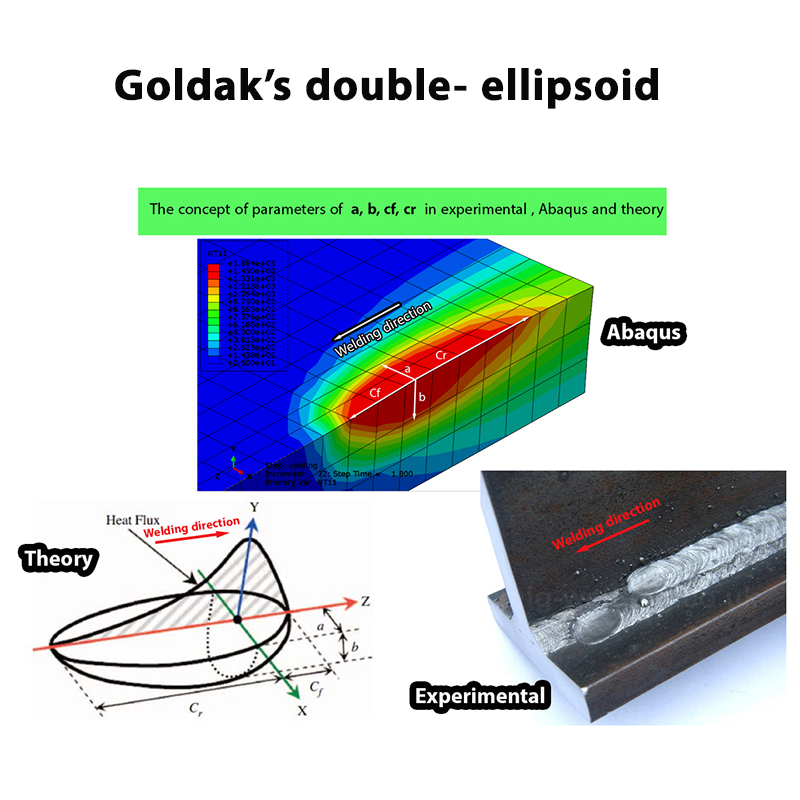
In this educational tutorial, you will learn about the Goldak's double-ellipsoid heat source model and how it can be used in Abaqus to represent the heat input during the arc welding process.
The Goldak double-ellipsoid model is one of the widely used heat source models for simulating arc welding. It represents the heat input as a volumetric heat flux distributed within the workpiece.
Goldak's Double-Ellipsoid Heat Source
The Goldak heat source consists of two ellipsoidal regions, representing the front and rear portions of the heat source. The size and shape of these two regions are defined using four main parameters: a, b, cf, and cr.
These parameters control the dimensions of the double-ellipsoid heat source and determine how the heat is distributed inside the workpiece.
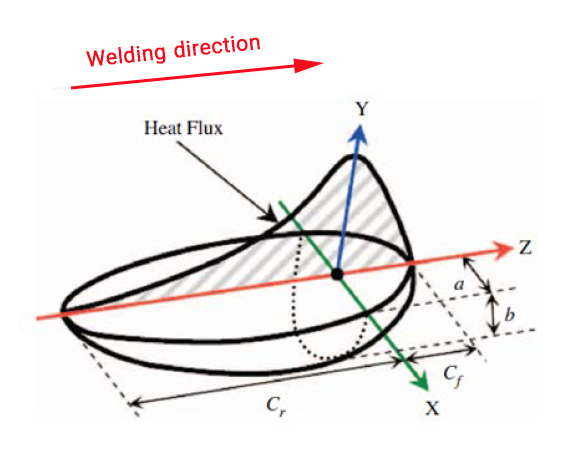
Main parameters defining the Goldak double-ellipsoid heat source.
Goldak Heat Source Parameters
The four main geometric parameters used in the Goldak model are a, b, cf, and cr.
- a – half-width of the ellipsoid.
- b – depth of the ellipsoid.
- cf – length of the front ellipsoidal region.
- cr – length of the rear ellipsoidal region.
Experimental Weld Pool
During an actual arc welding process, an approximately oval-shaped weld pool is produced on the workpiece. The dimensions of this region can be used to determine the parameters of the Goldak heat source.
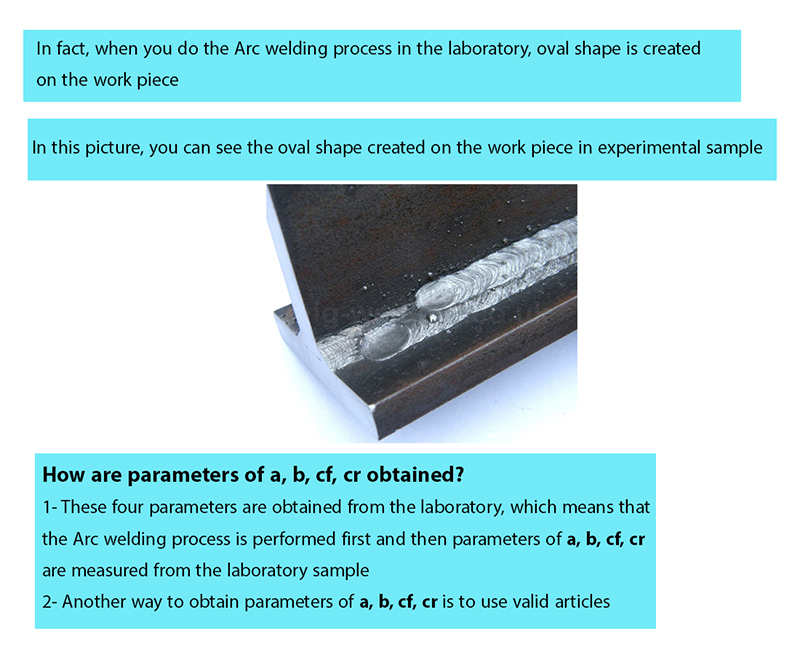
Oval-shaped weld pool observed in an experimental sample.
How to Obtain the Goldak Parameters
There are two main approaches for obtaining the parameters a, b, cf, and cr.
In the first approach, the arc welding process is performed experimentally in the laboratory. The resulting weld pool is then examined and the required dimensions are measured from the experimental sample.
In the second approach, the required parameters can be obtained from reliable research articles that provide the parameters of the Goldak double-ellipsoid heat source.
Determining Goldak heat source parameters from experimental results.
Implementation in Abaqus
In this tutorial, the Goldak double-ellipsoid heat source model is explained and its important parameters are discussed for use in Abaqus.
The tutorial focuses on understanding the Goldak heat source model and the parameters required to define it in Abaqus.
What You Will Learn
- What the Goldak double-ellipsoid heat source model is.
- How the Goldak model represents volumetric heat flux.
- How the Goldak model is used in arc welding simulations.
- How the front and rear ellipsoidal regions are defined.
- What the parameters a, b, cf, and cr represent.
- How the Goldak parameters can be obtained experimentally.
- How reliable research articles can be used to obtain Goldak parameters.
- How the Goldak heat source model can be implemented in Abaqus.
Key Features
- Goldak double-ellipsoid heat source model.
- Arc welding heat source modeling.
- Volumetric heat flux representation.
- Front and rear ellipsoidal heat source regions.
- Parameters a, b, cf, and cr.
- Explanation of experimental parameter determination.
- Explanation of obtaining parameters from research articles.
- Abaqus implementation without a subroutine.
- Free educational tutorial.
Amr Ahmed
it is a very good tutorial
i need the D-flux subroutine and i have another question if i have ABAQUS 2017 this D-flux subroutine works also or not
Admin
Hello
This model is made without subroutine, but you can see the models with subroutine in the link below
https://www.7abaqus.com/product/arc-welding-course-in-abaqus/
Also, subroutines work in Abaqus 2017