
Product Overview
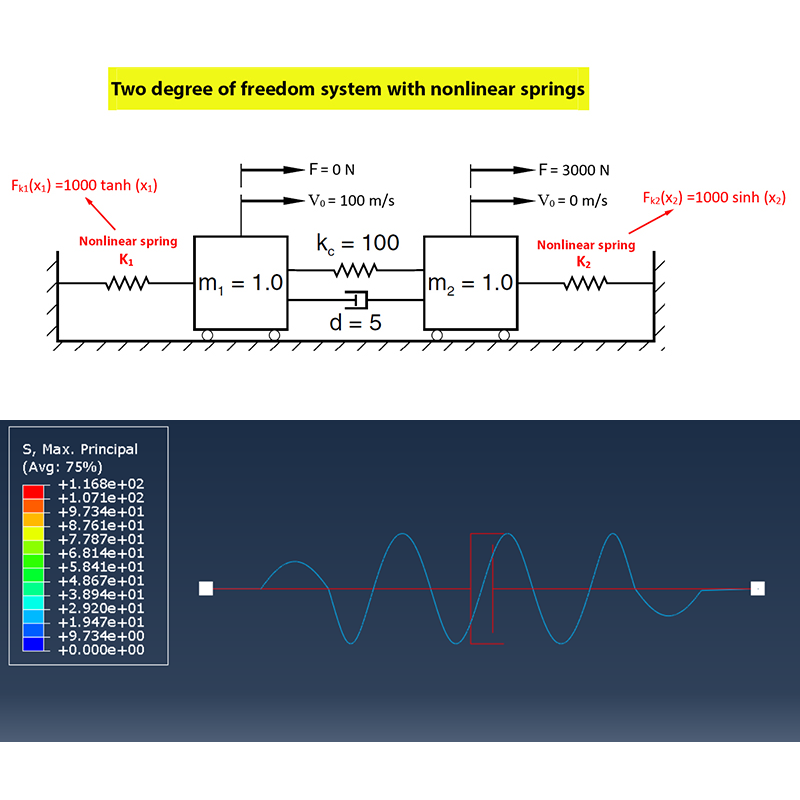
In this example, we intend to simulate a two-degree-of-freedom system with non-linear springs using the Abaqus software.
The system consists of two masses, M1 and M2, which are connected to each other by a spring and damper. Non-linear springs are also utilized on the left and right sides of the system.

Two-Degree-of-Freedom System
In this mechanical system, the two masses M1 and M2 interact through a spring and damper, while non-linear springs are placed at the two ends of the system.
The velocity and force applied to each mass are defined separately. The initial velocity of M1 is 100 m/s, while a force of 3000 N is applied to M2.

Non-Linear Springs
Non-linear springs are used on both sides of the system to represent the non-linear force-displacement behavior of the mechanical system.
The force-displacement characteristics of the non-linear springs are defined and used in the Abaqus model. The corresponding spring properties are also provided in the included Excel file.
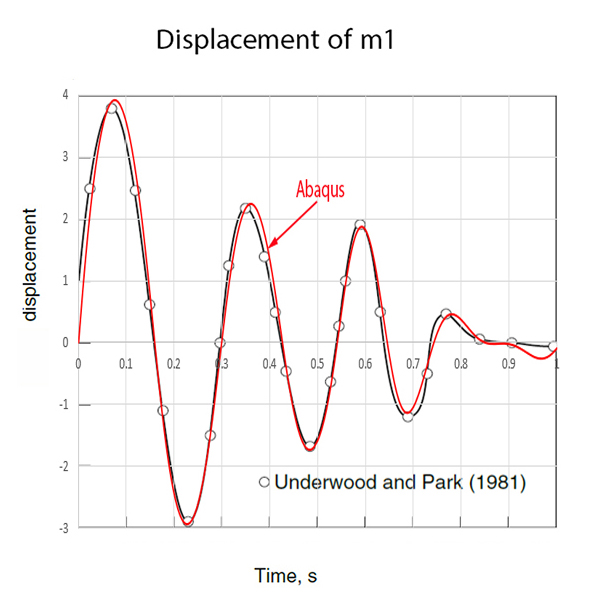
Velocity and displacement of M1
In this section, the velocity and displacement of M1 obtained from the Abaqus simulation are compared with the results of the analytical solution..

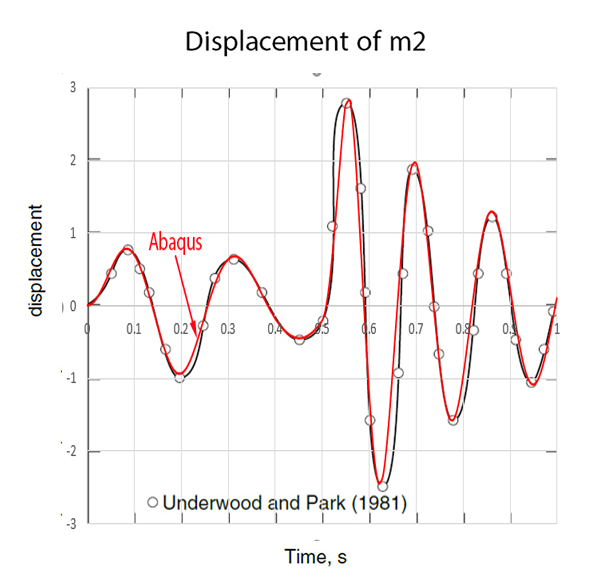
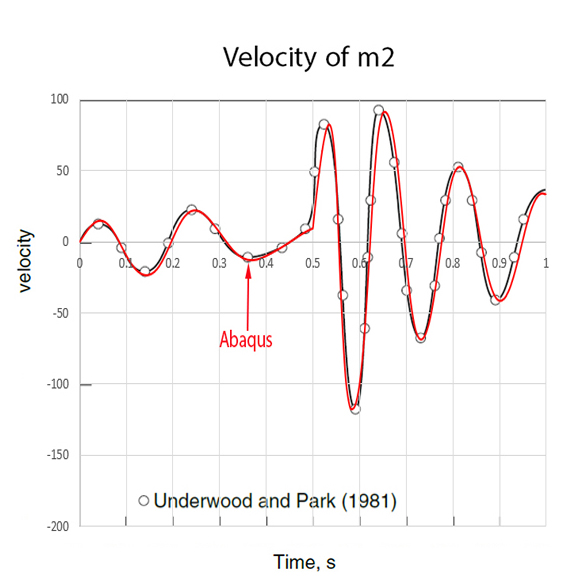
Velocity and displacement of M2
In this section, the velocity and displacement of M2 obtained from the Abaqus simulation are compared with the results of the analytical solution..
Abaqus Validation
The two-degree-of-freedom system is solved analytically, and the same system is simulated in Abaqus software.
The main purpose of this analysis is to obtain the velocity and displacement diagrams of both M1 and M2 and compare the Abaqus results with the corresponding analytical results.
The velocity and displacement responses of both masses obtained from Abaqus are then compared with the corresponding analytical results. The close agreement between the two approaches verifies the accuracy of the Abaqus model.
What You Will Learn
- How to model a two-degree-of-freedom system in Abaqus.
- How to define two interacting masses.
- How to define linear springs and dampers in Abaqus.
- How to define non-linear springs in Abaqus.
- How to define an initial velocity for a mass.
- How to apply an external force to a mass.
- How to obtain velocity and displacement results.
- How to obtain the analytical solution of the system.
- How to compare Abaqus results with analytical results.
- How to verify an Abaqus model using an analytical solution.
Key Features
- Two-degree-of-freedom dynamic system.
- Two masses, M1 and M2.
- Non-linear springs.
- Connecting spring and damper.
- Initial velocity of M1 = 100 m/s.
- Applied force on M2 = 3000 N.
- Velocity diagrams for M1 and M2.
- Displacement diagrams for M1 and M2.
- Analytical solution.
- Comparison between Abaqus and analytical results.
- Analytical validation of the Abaqus model.
Project Information
Important information about this project
Payment & Support
Need help with your purchase?
Secure Payment
Your payment is processed securely through our online payment system.
Need Help?
If you have any questions about this product, please contact us by email.
saeedofmoeini@gmail.com
There are no reviews yet.