
Project Overview
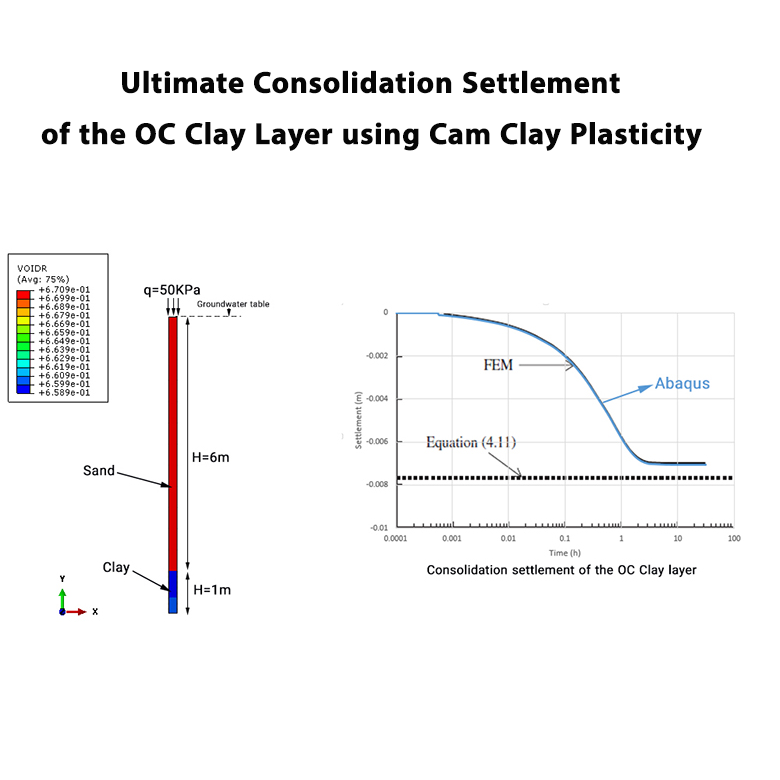
This tutorial focuses on the simulation of the ultimate consolidation settlement of an Over-Consolidated (OC) clay layer using the Cam Clay Plasticity model in Abaqus. This example is based on Example 4.4 from the Sam Helwany book.
The main objective is to simulate the consolidation behavior of the OC clay layer under an applied surface load and determine its ultimate consolidation settlement. The results obtained from Abaqus are then compared with the corresponding results presented in the Sam Helwany book.
Model Description
The soil profile consists of two layers. The upper layer is sand with a height of 6 m, while the underlying layer is clay with a height of 1 m.

Over-Consolidated Clay
The clay layer is considered to be Over-Consolidated (OC). The pre-consolidation pressure of the clay layer is 200 kPa, while the in-situ vertical effective stress at the center of the clay layer is 53.7 kPa.
Since the in-situ vertical effective stress at the center of the clay layer is lower than the pre-consolidation pressure, the clay layer is classified as Over-Consolidated (OC).
Geostatic Step
The analysis begins with a Geostatic step. In this step, the effective weight of the soil is applied using Body Force to establish the initial stress state within the soil.
Application of Compressive Load
In the second step, a compressive load of 50 kPa is suddenly applied to the top surface of the soil.
The applied load generates excess pore pressure and initiates the consolidation process within the clay layer.
Consolidation Analysis
Following the application of the compressive load, the consolidation process is simulated through six consecutive steps. The time periods are progressively increased to capture the development of consolidation settlement over time.

Cam Clay Plasticity
The clay layer is assumed to behave as an elastoplastic material following the Extended Cam Clay model.
The Extended Cam Clay model is used to represent the elastoplastic response of the over-consolidated clay during the consolidation analysis.

Ultimate Consolidation Settlement
The main objective of this analysis is to calculate the ultimate consolidation settlement of the OC clay layer.
The consolidation settlement is obtained from the Abaqus analysis, and the ultimate consolidation settlement diagram is generated based on the numerical results.

Results from Sam Helwany Book
The corresponding consolidation settlement results presented in the Sam Helwany book are used as a reference for evaluating the Abaqus simulation.

Comparison of Results
The consolidation settlement results obtained from Abaqus are compared with the corresponding results from the Sam Helwany book.
This comparison is used to evaluate the accuracy of the numerical model and verify the simulation of the consolidation behavior of the OC clay layer.

What You Will Learn
- How to model a two-layer soil profile in Abaqus.
- How to define sand and clay layers.
- How to establish the initial geostatic stress state.
- How to apply the effective weight of soil using Body Force.
- How to identify an Over-Consolidated (OC) clay layer.
- How to define the Extended Cam Clay plasticity model.
- How to apply a sudden compressive load of 50 kPa.
- How to perform a consolidation analysis in Abaqus.
- How to define multiple consolidation steps.
- How to calculate the ultimate consolidation settlement of OC clay.
- How to compare Abaqus results with the Sam Helwany book.
Key Features
- Two-layer soil profile.
- 6 m sand layer.
- 1 m clay layer.
- Over-Consolidated (OC) clay.
- 200 kPa pre-consolidation pressure.
- 53.7 kPa in-situ vertical effective stress.
- Extended Cam Clay plasticity model.
- Geostatic initial stress analysis.
- 50 kPa sudden compressive loading.
- Six consecutive consolidation steps.
- Consolidation time periods from 1 to 100,000 seconds.
- Ultimate consolidation settlement calculation.
- Comparison with Sam Helwany Example 4.4.
- Free Abaqus tutorial.
Project Information
Important information about this project
Payment & Support
Need help with this tutorial?
Free Tutorial
This Abaqus tutorial is available free of charge.
Need Help?
If you have any questions about this tutorial, please contact us by email.
saeedofmoeini@gmail.com
There are no reviews yet.