
Project Overview
This tutorial focuses on the simulation of vertical stress in layered soil caused by circular loading using Abaqus software. This example is based on Example 3.8 from the Sam Helwany book.
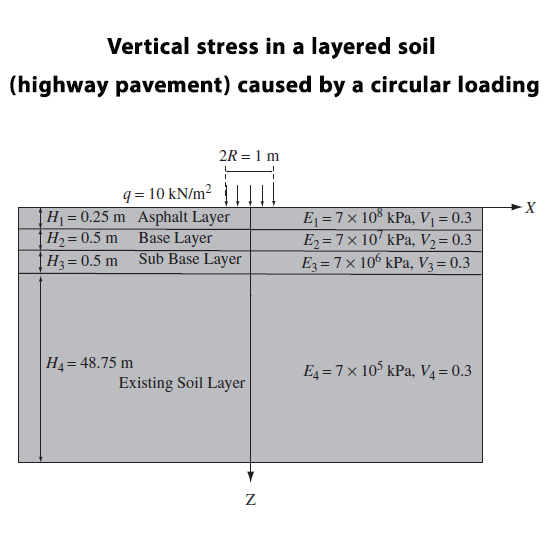
The model represents a typical layered soil system beneath a highway pavement. The vertical stress generated by the applied circular load is obtained from the Abaqus analysis and compared with the corresponding results presented in the Sam Helwany book.
Model Description
The soil system is modeled as a cylindrical domain with a height of 50 m and a diameter of 100 m.
The model consists of four different layers representing the pavement and underlying soil. Each layer has a different thickness and material properties.

Soil and Pavement Layers
The layered soil system consists of four layers. The first layer is the Asphalt layer with a thickness of 0.25 m.
The second layer is the Base layer, which has a thickness of 0.5 m.
The third layer is the Sub-base layer with a thickness of 0.5 m.
The final layer is the Existing Soil layer, which has a thickness of 48.75 m.

Circular Loading
A circular loading area is defined on the top surface of the pavement. A uniform pressure of 10 kPa is applied to the circular loading area.
The applied pressure generates stresses within the pavement layers and the underlying soil. The resulting vertical stress distribution is obtained from the Abaqus analysis.
Vertical Stress Within the Layered Soil
The main objective of this analysis is to determine the increase in vertical stress within the layered soil caused by the circular surface loading.
The stress distribution is obtained at different locations within the layered system to investigate how the applied load is transferred through the asphalt, base, sub-base, and existing soil layers.

Results from Sam Helwany Book
The corresponding vertical stress results from the Sam Helwany book are used as a reference for evaluating the Abaqus simulation.
The theoretical results provide a basis for checking the stress distribution obtained from the numerical model.

Comparison of Results
The results obtained from Abaqus are compared with the corresponding results from the Sam Helwany book.
This comparison is used to evaluate the accuracy of the numerical model and to verify the simulation of vertical stress in the layered soil system.

What You Will Learn
- How to model a three-dimensional layered soil system in Abaqus.
- How to create a cylindrical soil domain.
- How to model an asphalt layer.
- How to model base and sub-base layers.
- How to model the existing soil layer.
- How to apply a circular surface load.
- How to apply a uniform pressure of 10 kPa.
- How to investigate vertical stress within layered soil.
- How to evaluate stress transfer through different soil layers.
- How to compare Abaqus results with Sam Helwany book results.
Key Features
- Three-dimensional layered soil model.
- Highway pavement model.
- 50 m total model height.
- 100 m model diameter.
- Four different layers.
- 0.25 m asphalt layer.
- 0.5 m base layer.
- 0.5 m sub-base layer.
- 48.75 m existing soil layer.
- 10 kPa circular surface pressure.
- Vertical stress analysis.
- Comparison with Sam Helwany Example 3.8.
- Free Abaqus tutorial.
Project Information
Important information about this project
Payment & Support
Need help with this tutorial?
Free Tutorial
This Abaqus tutorial is available free of charge.
Need Help?
If you have any questions about this tutorial, please contact us by email.
saeedofmoeini@gmail.com
There are no reviews yet.