
Project Overview
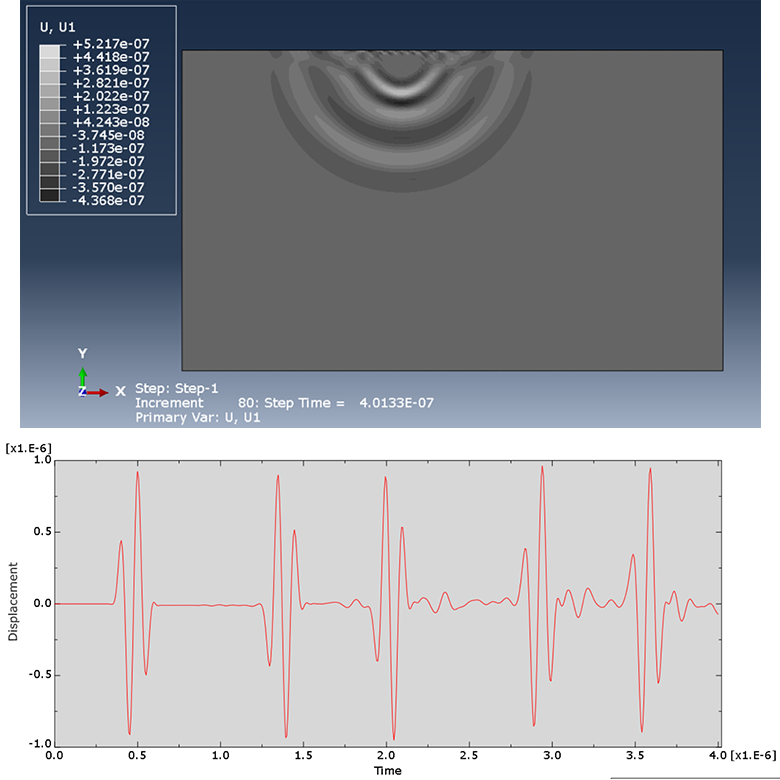
In this example, wave propagation is simulated in Abaqus with and without using infinite elements. The main objective is to investigate the effect of infinite elements on wave propagation and compare the obtained results.
The results obtained from a model with infinite elements are compared with those from a model without infinite elements. This comparison clearly demonstrates the effect of infinite elements on wave reflection and energy absorption.
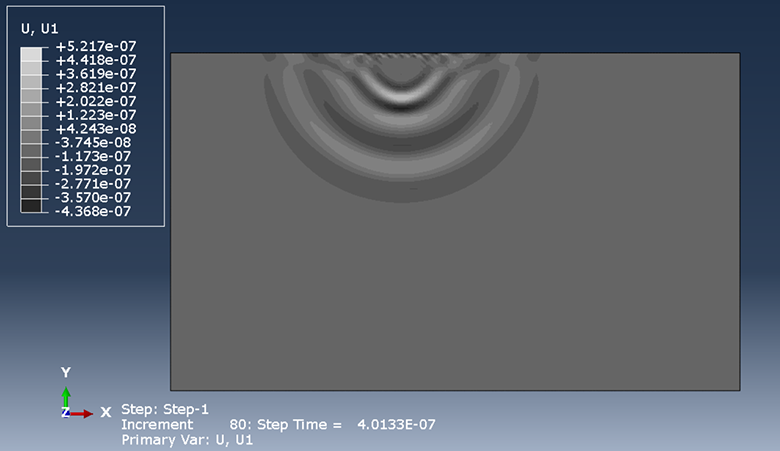
Wave propagation model used in the Abaqus simulation.
Cosine Pulse Loading
A pulsing load in the form of a cosine function is applied to the model to generate the propagated wave.
The cosine loading is used as the input excitation for the wave propagation analysis, and the response of the model is investigated during the simulation.
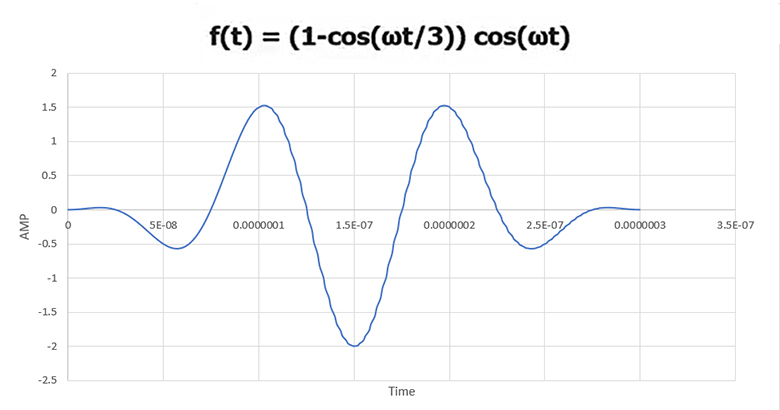
Cosine pulse loading applied to generate the wave.
Wave Propagation without Infinite Elements
First, the model is analyzed without using infinite elements.
When the propagated wave reaches the bottom of the model, it is reflected back into the model instead of leaving the analysis domain. As a result, a clear wave reflection phenomenon can be observed.
The reflected wave travels back through the model and can repeatedly bounce between the boundaries. This produces a repetitive to-and-fro wave movement.

Wave reflection in the model without infinite elements.
Vertical Displacement without Infinite Elements
The vertical displacement of point A is monitored during the analysis without infinite elements.
The reflected waves affect the displacement response of point A, resulting in repeated oscillations caused by the wave reflection from the boundaries.
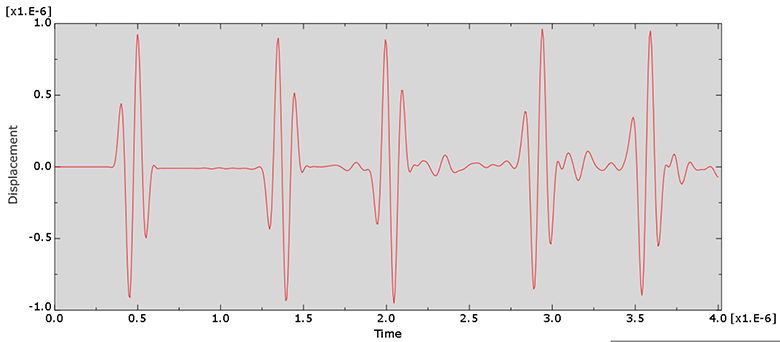
Vertical displacement of point A without infinite elements.
Wave Propagation with Infinite Elements
In the next step, the same problem is analyzed using infinite elements.
When the propagated wave reaches the bottom of the model, the infinite elements allow the wave energy to leave the model instead of reflecting it back into the analysis domain.
Therefore, the wave reflection phenomenon is significantly reduced, allowing the model to better represent wave propagation into an unbounded domain.
Vertical Displacement with Infinite Elements
The vertical displacement of point A is also obtained for the model containing infinite elements.
Compared with the model without infinite elements, the displacement response is less affected by reflected waves because the wave energy is allowed to leave the model.
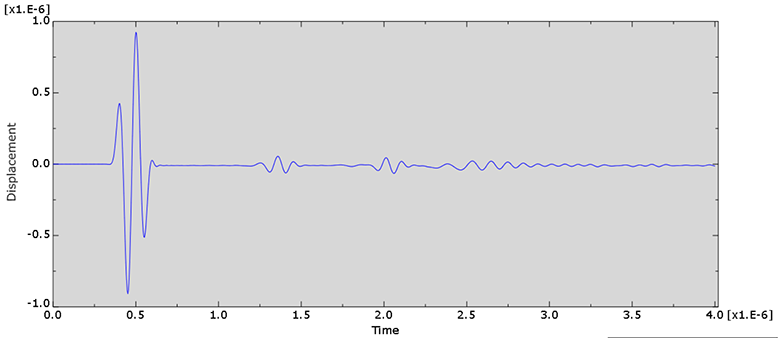
Vertical displacement of point A with infinite elements.
Energy Absorption by Infinite Elements
The energy absorbed by the infinite elements is also evaluated during the analysis.
The results show that approximately 41 Joules of energy are absorbed by the infinite elements.
This demonstrates that the infinite elements can effectively absorb the wave energy and prevent a significant portion of it from returning to the model.

Energy absorbed by the infinite elements.
Comparison of Wave Propagation Results
The main difference between the two models is the behavior of the wave at the boundary. Without infinite elements, the wave is reflected back into the model. With infinite elements, the wave energy is absorbed and allowed to leave the model.
This comparison demonstrates why infinite elements can be useful for modeling wave propagation when the physical problem involves an unbounded or semi-infinite domain.
What You Will Learn
- How to simulate wave propagation in Abaqus.
- How to apply a cosine pulse loading.
- How to model wave propagation without infinite elements.
- How wave reflection occurs at the model boundary.
- How to model wave propagation using infinite elements.
- How infinite elements reduce wave reflection.
- How to monitor the vertical displacement of a point.
- How to evaluate energy absorbed by infinite elements.
- How to compare wave propagation results with and without infinite elements.
- How infinite elements can be used to represent an unbounded domain.
Key Features
- Wave propagation analysis.
- Comparison with and without infinite elements.
- Cosine pulse loading.
- Wave reflection investigation.
- Vertical displacement monitoring at point A.
- Energy absorption by infinite elements.
- Approximately 41 J of absorbed energy.
- Comparison of wave propagation responses.
- Step-by-step training video.
- Abaqus CAE file.
- Abaqus INP file.
- Excel file containing the cosine function.
Project Information
Important information about this project
Payment & Support
Need help with your purchase?
Secure Payment
Your payment is processed securely through our online payment system.
Need Help?
If you have any questions about this product, please contact us by email.
saeedofmoeini@gmail.com
There are no reviews yet.